Oh Christmas Oh Chemistree: An Embroidery Review
As a professional designer and product reviewer who spends countless hours testing digital assets for real-world application, I approach every new graphic with a specific question: will this actually stitch out well? When evaluating Oh Christmas Oh Chemistree, my focus shifts immediately from screen to fabric. This design sits at the intersection of holiday whimsy and scientific niche appeal, making it a unique candidate for custom apparel and specialized gifts. However, translating a vector graphic into a tangible machine embroidery design requires careful consideration of structure, density, and end-use.
First Impressions and Visual Personality
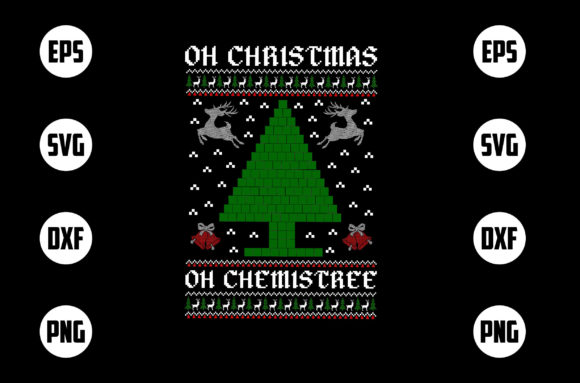
Upon opening the EPS file, the first thing that stands out is the clever integration of chemistry iconography into a traditional holiday silhouette. The mood is undeniably festive yet intellectually playful. For an Etsy seller or craft business owner targeting STEM professionals, students, or science enthusiasts, this graphic offers immediate recognition. It avoids the generic nature of standard holiday clip art, providing a distinct visual personality that can elevate a handmade product above mass-market alternatives.
The layout appears balanced for center-chest placement on sweatshirt embroidery or as a primary focal point on a tote bag design. As a vector-based asset within the T-Shirt Designs category, the lines are crisp, which is promising for digitizing. Clean vectors typically translate better to satin stitch borders and defined fill stitch areas than raster images. However, because this is supplied as a graphics file rather than a pre-digitized embroidery file, the success of the final embroidery project will depend heavily on how you or your digitizer interprets these shapes into stitches.
Real-World Application: The Lab Coat and Tote Test
To truly judge the viability of Oh Christmas Oh Chemistree, I mentally placed it in a specific production scenario: creating a personalized gift for a chemistry teacher or lab researcher. In this context, the design needs to perform on varied substrates. I envision stitching this onto a canvas tote bag and a cotton-poly blend lab coat.
For the tote bag design, the canvas texture provides a stable foundation. The design’s likely combination of bold outlines and internal details would pop against the natural fabric, especially if using high-contrast thread colors like forest green and bright red. Canvas forgives minor density issues, making it a safe bet for this graphic. However, for the lab coat, which often features twill weave and potential water-resistant coatings, the strategy changes. Here, the design must be dense enough to prevent the fabric texture from showing through the stitches but not so dense that it causes puckering or needle damage. This dual-purpose potential makes it a valuable asset for commercial embroidery businesses looking to offer niche holiday embroidery options without purchasing multiple single-use designs.
Critical Considerations for Fabric and Hoop Size
While the concept is strong, practical execution requires caution. Not every surface is suitable for Oh Christmas Oh Chemistree without modification. If you plan to use this for baby embroidery or lightweight knits, you must evaluate the stitch density carefully. Vector graphics intended for print often contain intricate details that become problematic when converted to thread. Tiny molecular structures or thin connecting lines may require running stitch work that can get lost on textured fabrics or cause tension issues on stretchy material.
I strongly advise against using this design on highly curved surfaces like caps unless you have verified the digitization specifically for headwear. The spatial relationship between the "tree" elements and any text components may distort on a curved brim. Similarly, for small hoop sizes, resizing is a risk. Reducing a complex chemistry-themed design below its optimal threshold can result in muddy details where atoms and branches merge into an unrecognizable blob. Always confirm the minimum viable size before committing to a production run.
Dark fabrics present another challenge. If the original graphic relies on negative space or light-colored linework, you may need to add a white underlay or adjust the color palette entirely to ensure visibility on navy or black garments. This is crucial for maintaining the professional appearance expected in custom apparel.
Impact on Product Value and Customer Trust
In the competitive landscape of digital product sellers and handmade markets, presentation is everything. Using Oh Christmas Oh Chemistree effectively can significantly boost buyer engagement. A well-executed stitch-out demonstrates competence. When customers see clean registration, appropriate stabilizer usage, and thoughtful color choices in your printable mockup or product photos, it builds trust. They aren't just buying a cute shirt; they are buying quality assurance.
Conversely, poor execution devalues the brand. If the design looks flat, pulls the fabric, or lacks definition, it reflects poorly on your shop regardless of how charming the original vector art is. For small shop products, consistency is key. This design has the potential to become a seasonal staple in your catalog, but only if the physical output matches the digital promise. The specificity of the theme also aids in SEO and discoverability; customers searching for science-related holiday gifts are more likely to convert on a targeted design than a generic one.
Designer Notes for Successful Implementation
Before listing any finished item or selling this as part of a bundle, adhere to these practical protocols:
- Verify Licensing and Formats: The product description mentions an EPS vector file. Confirm whether you have the rights to sell the digitized embroidery version or only physical goods. Never assume commercial rights for design assets without explicit permission.
- Test Stitch on Scrap Fabric: Never run a new design directly on a client’s garment. Test on a scrap that matches the weight and weave of your final substrate. Check for puckering, thread breaks, and detail clarity.
- Evaluate Stabilizer Pairing: For knit sweatshirts, use a cut-away stabilizer to prevent distortion. For woven tote bags or aprons, a tear-away may suffice. The wrong stabilizer choice can ruin even the best embroidery file.
- Check Thread Contrast: View your digitized preview in grayscale. If the design loses definition without color, the contrast is insufficient. Adjust density or add texture to differentiate overlapping elements.
- Mockup Realism: When creating listings, use mockups that reflect actual stitch texture. Avoid flat, printed-looking previews for embroidery products. Customers need to visualize the raised texture and sheen of the thread.
- Inspect Small Details: If the chemistry symbols include tiny text or sub-millimeter elements, consider simplifying them during digitization. Thread has physical limitations that ink does not.
Final Verdict for Makers and Sellers
Oh Christmas Oh Chemistree represents a fantastic opportunity for creators serving the academic and scientific community. Its blend of seasonal cheer and professional identity fills a specific market gap that generalist designs cannot. Whether you are producing personalized gifts for colleagues, stocking an Etsy shop with niche holiday embroidery, or expanding your commercial embroidery portfolio, this graphic offers substantial creative potential.
Success lies in respecting the medium. Treat the vector as a blueprint, not a guarantee. By applying rigorous testing, appropriate stabilization, and mindful digitizing practices, you can transform this digital asset into a premium finished product that delights customers and withstands the scrutiny of real-world wear. Always prioritize the integrity of the stitch over the speed of production, and this design will serve your business well throughout the holiday season and beyond.